The USA, UK, and Canada are the best countries for Bangladeshi students in 2026, known for their top-ranked universities, excellent career prospects, and strong post-study work opportunities.
Every year, over 50,000 Bangladeshi students go abroad for higher education, making it crucial to choose a country that fits your budget, career goals, and language requirements.
In this guide, we’ll break down the most important factors, compare the leading study destinations, and help you find the ideal country for your future.
Why Choosing the Right Country Matters
Choosing the right country for higher studies is more than just picking a place to study; it shapes your academic experience, career trajectory, and future opportunities.
The country you select determines the quality of education, global recognition of your degree, post-study work options, and even your long-term settlement prospects.
For Bangladeshi students, making an informed choice ensures that your investment in education leads to meaningful career growth, higher earning potential, and a smooth transition to international work or further studies.
6 Critical Factors Before Picking Your Study Destination
For Bangladeshi students, choosing the wrong country not only delays their studies but can also result in visa cancellation, increased financial pressure, difficulty in finding a good job, and even being forced to return home after completing their studies.
Therefore, it is most important to understand the real situation, not just advertisements, when making a decision.
1. Career Goals (Employability & Global Demand)
Degrees from all countries are not equally valued in the job market. In some countries, international students may earn good degrees but have very few job opportunities after graduation.
So it is important to check whether the country you are choosing hires foreign graduates in your field, whether there are legal opportunities to work, and whether there is a demand for skills related to your field. It is not enough to just look at a university’s high ranking.
2. Budget & Total Cost (Tuition + Living + Hidden Costs)
Many Bangladeshi students underestimate the actual cost of studying abroad and think that the income from part-time work will be high.
But fluctuations in the value of the dollar, rising rents, health insurance costs, family expenses, and limited working hours can quickly create financial stress.
A good and sustainable study destination is one where tuition fees, daily expenses, and legitimate employment opportunities are realistically compatible with each other.
3. Post-Study Work & PR Opportunities
If you have to leave the country immediately after completing your studies, the value of that degree becomes very limited. This is because post-study work time, job sponsorship opportunities, and permanent residency (PR) pathways vary greatly from country to country.
The real issue is not whether a country is simply labeled PR-friendly, but whether international students in your subject can actually transition from student visas to work and residency.
4. University & Program Quality
No matter how big a university is, if the program is not relevant to your future, it won’t do you much good.
Many students choose a university without considering industry connections, internship opportunities, job placement rates after graduation, or the relevance of the course to the local job market.
A good program should be one that builds not just book knowledge, but also job-related skills that are acceptable to employers in that country.
5. Language Requirements (IELTS, MOI, Alternatives)
Language requirements affect both admission and visa success. Although MOI or Alternative Language Tests often make it easier to get admission, some countries and visa officers carefully check English proficiency.
So it is better to choose a country where the language requirements are clear and apply equally to everyone. This reduces the risk of visa rejection and avoids last-minute hassles.
6. Visa Success Rate
Visa cancellations are often not due to the student, but rather to differences in regulations across countries.
Financial capacity requirements, interview rigor, previous visa history, and policy consistency vary from country to country.
So it is better to choose a country where visa regulations are clear and have a good record of visa approval for Bangladeshi students. This greatly reduces the risk, especially for those with an average educational profile.
Top 10 Countries for Bangladeshi Students to Study Abroad
Here is a country-wise analysis of the most popular study abroad destinations for Bangladeshi students, maintaining six factors, so that you can choose the best country according to your goals.
United States of America (USA)
The USA remains the top study destination globally, offering high-demand career fields like Computer Science, Engineering, Data Science, Management, and Healthcare with average salaries between $100,000–$150,000 per year.
International students typically spend $40,000–$60,000 annually, though top universities may exceed $80,000. Around 62% of international graduates gain US work experience through OPT.
Over 17,000 Bangladeshi students were enrolled in 2023–24, with 70–80% F-1 visa success rates. Most applicants submit IELTS, TOEFL, PTE, or Duolingo, and skilled graduates can later pursue H-1B and Green Card pathways. The United States of America (USA) ranks #1 worldwide for higher education quality.
United Kingdom (UK)
The UK offers high-demand career options for international students in Computer Science & IT (AI, Cybersecurity, Data Science), Engineering, Healthcare & Nursing, Business & Finance, and Biotechnology, with 85–95% employability rates and starting salaries of £30,000–£60,000.
Annual study costs range from £25,000 to £45,000, including £15,000 to £35,000 tuition and £10,000 to £15,000 living expenses, depending on location and program. The Graduate Route visa allows 2 years of post-study work (3 for PhDs); among 10,000–15,000 Bangladeshi students, around 70–80% secure jobs in high-demand fields.
Graduates can move to the Skilled Worker visa, leading to ILR after 5 years, with 20–40% of Bangladeshi STEM graduates achieving PR, especially in IT and nursing.
The UK accepts IELTS, TOEFL, PTE, and Trinity ISE, with 95%+ Bangladeshi applicants submitting IELTS or PTE, and maintains an 85–95% student visa success rate. The United Kingdom (UK) ranks #2 worldwide for higher education quality.
Canada
Canada offers globally in-demand career fields for international students in Computer Science, Engineering, Healthcare (Nursing/Public Health), Business Analytics, and Data Science, with 85–95% employability and starting salaries of CAD 60,000–90,000.
The annual cost of study ranges from CAD 30,000 to 55,000, including tuition of CAD 20,000–40,000 and living expenses of CAD 10,000–15,000, with higher costs in cities like Toronto and Vancouver.
The Post-Graduation Work Permit (PGWP) allows up to 3 years of work, and among 25,000+ Bangladeshi students, around 70–85% secure jobs, mainly in STEM fields. Canada offers strong PR pathways through Express Entry and Provincial Nominee Programs, with 40–60% of Bangladeshi graduates achieving PR within 3–5 years via the Canadian Experience Class.
Accepted English tests include IELTS, TOEFL, PTE, CELPIP, and Duolingo, with 95%+ Bangladeshi applicants using IELTS (6.0–6.5) or SDS-equivalent scores.
Study permit success from Bangladesh ranges from 70–90% via SDS, though overall approval rates dipped in 2025 due to study caps; strong academic profiles can still achieve 95%+ success. Canada ranks #4 worldwide for higher education quality.
Australia
Australia offers globally in-demand career options for international students in Nursing & Healthcare, IT/Computer Science, Engineering, Social Work, and Construction Management, with strong PR pathways and starting salaries of AUD 70,000–95,000.
Annual study costs range from AUD 35,000–60,000, including AUD 25,000–45,000 tuition and AUD 10,000–15,000 living expenses, with higher costs in Sydney and Melbourne. The Temporary Graduate visa (Subclass 485) provides 2–4 years of post-study work; among 20,000–30,000 Bangladeshi students, around 75–90% secure jobs in priority sectors.
PR is achievable through GSM and state nomination pathways, with 50–70% of Bangladeshi graduates in nursing, IT, and engineering gaining PR within 3–5 years. Australia accepts IELTS, TOEFL iBT, PTE Academic, and Cambridge English, with 95%+ Bangladeshi applicants submitting IELTS (6.5) or PTE equivalents.
The Subclass 500 student visa success rate is 80–95% for well-prepared applications. Australia ranks #4 worldwide for higher education quality.
Denmark
Denmark offers tuition-free public university education (small fee) with strong programs in Engineering, Computer Science/AI, Life Sciences, Business Analytics, and Environmental Science, boasting 85–95% employability and starting salaries of DKK 400,000–550,000 (~$13,000–$20,000 USD).
Living costs range from DKK 90,000 to 140,000 annually. Graduates get a 6-year residence permit to find work; 60–80% of Bangladeshi students secure jobs. PR is possible via the Positive List after 4 years, with 30–50% of Bangladeshi STEM graduates achieving it.
Accepted tests are IELTS, TOEFL, PTE, and Cambridge C1, with 95%+ using IELTS. Student visa approval rates from Bangladesh are between 80–90%, and Denmark ranks #10 worldwide for higher education.
Sweden
Sweden offers high-quality education, with tuition-free public universities for EU/EEA students and SEK 80,000–140,000/year for non-EU students. Key fields include IT/Software Engineering (AI, Cybersecurity), Engineering, Healthcare, Data Science, and Business, with 85–95% employability and starting salaries of SEK 30,000–45,000/month.
Annual costs range SEK 120,000–200,000 ($11,000–$19,000 USD), mainly living expenses. Graduates receive a 12-month job search extension, with 65–85% of Bangladeshi students securing roles in high-demand sectors. PR is possible after 4 years via work permits, with 35–55% of Bangladeshi STEM graduates achieving it.
Accepted tests include IELTS, TOEFL, PTE, and Cambridge C1, with 95%+ using IELTS. Student residence permit success from Bangladesh is 90–95%, and Sweden ranks #9 globally for higher education quality.
Malta
Malta offers affordable, English-taught programs in iGaming/Blockchain, IT/Cybersecurity, Business/Finance, Nursing, and Tourism, with 80–90% employability and starting salaries of €25,000–€40,000.
Annual costs range from €12,000 to €25,000, including €7,000–20,000 tuition and living expenses of €600–1,000/month, lower outside Valletta. Graduates receive a 6-month job search extension, with 60–75% of Bangladeshi students securing jobs in high-demand sectors.
PR is possible after 5 years via the work permit scheme, with 25–45% of Bangladeshi graduates achieving residency in shortage occupations like IT and nursing.
Hungary
Hungary offers affordable English-taught programs, often via the Stipendium Hungaricum scholarship, with strengths in Medicine, Engineering, IT, Business, and Agriculture Technology.
Employability is 80–90%, with starting salaries of HUF 500,000–800,000/month (€1,200–€2,000). Annual costs range from €5,000 to €15,000 without scholarships, including tuition (€2,400–16,000) and living expenses (€400–700/month).
Graduates receive a 9-month job search permit, with 60–80% of Bangladeshi students securing roles in shortage fields. PR is possible after 8 years (or 3 with integration), with 30–50% of Bangladeshi graduates achieving residency in medicine/IT.
Accepted tests include IELTS, TOEFL, PTE, or MOI certificates, with 95%+ using IELTS. Student visa (D-type) success is 85–95%, aided by scholarships and complete documentation. Hungary ranks #35 globally for higher education.
UAE (Dubai)
Dubai (UAE) attracts international students with modern campuses and tax-free career opportunities in business and tech hubs. Annual costs range from AED 60,000–150,000 ($16,000–$41,000 USD), including tuition of AED 40,000–120,000 and living expenses of AED 20,000–30,000.
Student visas (1–5 years) allow part-time work, with 70–85% of Bangladeshi students securing jobs; fewer than 1,000 are enrolled. High achievers can qualify for the Golden Visa (5–10 years), leading to long-term residency, with 40–60% of Bangladeshi graduates in shortage fields like IT and engineering eligible. The United Arab Emirates (Dubai) ranks #28 worldwide for higher education.
Malaysia
Malaysia is an affordable, English-friendly study destination in Asia, popular with Bangladeshi students seeking careers in IT/AI/Cybersecurity, Engineering, Business/Fintech, Healthcare, and Data Science, with 80–90% employability and starting salaries of MYR 4,000–8,000/month.
Annual costs range from MYR 25,000–60,000 ($6,000–$14,000 USD), including tuition MYR 15,000–40,000 and living expenses MYR 10,000–20,000, lower outside Kuala Lumpur. Graduates have a 6–12 month job search pass, with 65–80% of Bangladeshi students securing roles in IT/healthcare.
Long-term residency is possible via MM2H or employment passes, with 20–40% of Bangladeshi graduates in priority sectors qualifying. Accepted tests include IELTS, TOEFL, PTE, and MUET, with 95%+ using IELTS. Student pass success from Bangladesh is 85–95%, and Malaysia ranks #37 worldwide for higher education.
Best Countries To Study Abroad For Bangladeshi Students Based on Specific Goal
As a third-world country, Bangladesh has some challenges for students, such as budget issues and part-time income patterns. The countries are given below according to specific goals:
Low-Budget
Hungary is widely recognized as the best country for low-budget Bangladeshi students, offering affordable tuition (€5,000–15,000) and scholarships like Stipendium Hungaricum.
This makes it ideal for applicants who want quality education abroad without stretching their finances.
Permanent Residency (PR)
Canada is considered the best country for permanent residency (PR) for students aiming for long-term settlement.
With Express Entry and Provincial Nominee Programs (PNP), 40–60% of STEM graduates can secure PR within 3–5 years, making it one of the fastest and most reliable routes to permanent residency.
Part-Time Income
For students aiming for high part-time income, Dubai (UAE) is an ideal destination. Its tax-free salaries, thriving business and tech hubs, and abundant part-time work opportunities during studies make it highly attractive for those seeking strong financial returns, both while studying and after graduation.
Fast Graduation
The UK is widely regarded as the best country for fast graduation, making it ideal for students who want to complete their studies quickly.
Most bachelor’s programs take just 3 years, while master’s programs are only 1 year. Combined with the Graduate Route visa for post-study work, this enables faster career progression and a quicker transition into the global job market.
Without IELTS / With MOI
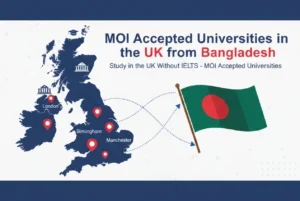
The UK is the top choice for Bangladeshi students who want to study abroad without IELTS, as many universities accept the Medium of Instruction (MOI) certificates.
This makes it easier for applicants with English-taught academic backgrounds to apply and secure admission without taking an English test.
Common Mistakes Bangladeshi Students Must Avoid
Mistake 1: Choosing a university based solely on brand name or popular opinion without checking course quality, global ranking, career services, and alumni outcomes can lead to regret.
Mistake 2: Many students focus only on tuition and ignore living expenses, health insurance, visa fees, and travel costs, which can lead to financial stress abroad.
Mistake 3: Failing to research or apply for merit-based, need-based, or government scholarships can mean losing out on substantial financial support.
Mistake 4: Incomplete documentation, ignoring language requirements, or misunderstanding visa regulations can lead to visa delays or rejection.
Mistake 5: Not exploring post-study work visas, internships, and networking opportunities early can make it harder to secure jobs in the host country after graduation.
Mistake 6: Waiting too long to apply for universities or visas can result in missed intakes or higher fees.
Mistake 7: Failing to prepare for cultural differences, academic expectations, and local laws can lead to social challenges, low academic performance, or compliance issues.
Mistake 8: Taking high-interest loans without understanding repayment obligations or not having a backup financial plan can lead to long-term financial stress.
AIMS Education Approach: How to Help You Choose the Right Country
As the leading education consultant in Bangladesh, AIMS Education addresses this challenge through a structured study-abroad service that looks beyond rankings and trends.
We carefully match students’ academic backgrounds with the right courses, available scholarship opportunities, and the most suitable intake for studying abroad, guiding them from Bangladesh to the best destinations.
So, Which Country Should You Go to Study in 2026 From Bangladesh?
Choosing the best country for Bangladeshi students depends on quality education, career opportunities, and long-term prospects, and the US, UK, and Canada consistently lead in all three areas.
Of the 6.9 million international students in 2022, these destinations are home to 39% of the world’s students, with the US (1,126,690), Canada (842,760), and the UK (758,855) proving their global credibility and appeal.
If you’re planning a trip to study abroad, now is the time to research programs, prepare documents, and take the first step. The right choice today can shape a strong academic future and a global career tomorrow.
FAQs
Which country is best overall for Bangladeshi students in 2026?
The USA, UK, and Canada are the best overall due to high-quality education, strong job markets, post-study work options, and global degree recognition.
Which country is best for permanent residency (PR) after study?
Canada offers the most reliable PR pathways through Express Entry and Provincial Nominee Programs, especially for STEM and healthcare graduates.
Which country is most affordable for Bangladeshi students?
Hungary and Malaysia are among the most budget-friendly options, offering low tuition fees, scholarships, and reasonable living costs.
Can Bangladeshi students study abroad without IELTS?
Yes. The UK, Hungary, and some European countries accept MOI or alternative English tests, depending on the university and program.
Which country has the highest visa success rate for Bangladeshi students?
The UK, Canada (via SDS), Australia, and Sweden generally have high visa success rates when applications are well-prepared and financially compliant.